
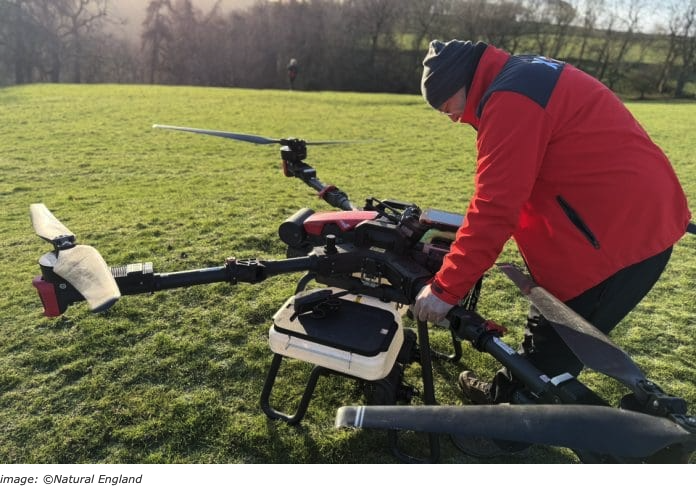
A first-of-its-kind drone trial has successfully dispersed native tree seeds across steep Peak District ravines, providing a safe and innovative method to restore rare woodlands heavily impacted by ash dieback disease
On June 1, 2026, the “LIFE in the Ravines” project announced the launch of a pioneering drone seed-spreading trial in the Peak District. Led by Natural England, the initiative utilises specialised drones to combat the devastating impacts of ash dieback disease.
The trial marks one of the first times this technology has been applied to steep, compact ravine woodlands, targeting areas that are otherwise inaccessible to conservation teams on the ground.
Drone trials: Overcoming challenging terrain
The trial took place across a 0.75-hectare plot at Dovedale and an identically sized area at Lathkill Dale. The steep, rocky slopes of these dales present major safety and logistical challenges for traditional, hand-planted forestry efforts.
While traditional tree planting and manual seeding have been successfully carried out across less extreme slopes in the Peak District Dales by Natural England and the National Trust, some cliff faces are simply too dangerous or difficult for ground teams to work on safely.
By operating in these confined spaces, the drones offer a safe, efficient, and cost-effective alternative that replicates natural seed dispersal methods, mimicking the way seeds would blow and settle if mature trees were already present on the ridges.
While drone-led reforestation has previously been used in wide, open upland landscapes like the Scottish Highlands, this trial represents a significant technological shift into tight, enclosed ravine environments.
The drone deployment was managed by Quadrotor Services Ltd., working in partnership with AutoSpray Systems Ltd., the UK distributor of XAG Drones.
Targeted seed selection and canopy penetration
The trial used a carefully selected mix of native tree seeds chosen specifically from the project planting palette for ravine woodland restoration. The distributed selection included field maple, wych elm, alder, small-leaved lime, birch, rowan, yew, goat willow, crab apple, and holly.
The main operational focus during the flight paths was ensuring that the seed dispersal precisely penetrated the dense, existing tree canopy to reach the soil below.
Project partners will carefully monitor the success of the trial using seed-trapping trays to verify dispersal accuracy across the target zones. Additionally, teams will establish one-metre-square monitoring plots inside and outside the seeded boundaries to track germination rates and sapling survival over multiple annual visits.
These findings will be compared against unseeded control plots to fully assess the financial viability and cost-effectiveness of drone seeding compared to traditional hand-planting.
Project framework and environmental impact
The drone trial forms part of the broader “LIFE in the Ravines” partnership, which is led by Natural England alongside the Derbyshire Wildlife Trust, Staffordshire Wildlife Trust, the National Trust, and the Chatsworth Estate. The overarching project has already seen more than 100,000 trees planted across the Peak District Dales to mitigate the canopy loss caused by ash dieback.
Organisers emphasise that establishing these trees is vital for the local ecosystem. Healthy ravine woodlands stabilise the rocky ground, prevent soil erosion and flooding, capture carbon, and provide a critical habitat for regional wildlife. Data from previous open-terrain drone seeding in Scotland showed a 2.7 per cent germination rate, which significantly exceeded the standard 1 per cent baseline expectation for broadcast seeding.
Source: Open Access Government